How to support our dyslexic students with their writing skills
I have just completed this brilliant webinar by Amanda Hornby from the British Dyslexia Association, which has been an eye-opener for me to help Mark (my student with dyslexia) develop his writing skills and abilities.
Needless to say, Mark’s written tasks may appear chaotic to some teachers who might have failed to consider a learning difficulty (especially when we’re dealing with adult students in our classrooms). And it is this quote that was highlighted during our webinar what urged me to publish my blog entry today:
In some instances, individuals will simply become phobic about the whole process, or at best may consciously limit the amount of writing that they are prepared to do
.
It goes without saying that the TIME it takes for a student with dyslexic traits to develop writing strategies during a school year is extensive so teachers might consider setting aside between the region of one to two hours per week outside class to introduce and practice as well as to revise new abilities with their students.
Equally, allowing extra time for their student with dyslexia to complete their written tasks in class needs special consideration as the extra effort they must put into producing a written text can become e-x-h-a-u-s-t-i-n-g.
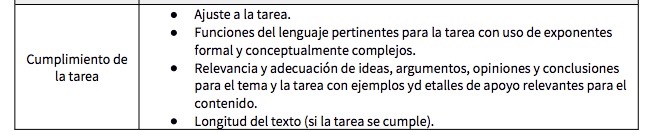
Take a look at the following assessment observation sheet used in Foreign Language Certificates to better understand how students like Mark truly require our support with respect to task fulfilment, organization, variety, lexicon and degree of accuracy.
And yet, given all of the issues outlined below, we are still guided by the same parameters we use to mark our non-dyslexic students’ written tasks.
PART ONE: TASK FULFILMENT
PART TWO: ORGANIZATION

PART THREE: LANGUAGE USAGE and VOCABULARY

PART FOUR: ACCURACY (including SPELLING)

The topics covered in your weekly sessions could deal with the following:
- tackling questions,
- note-taking,
- blank page syndrome,
- frameworks,
- planning and organising,
- vocabulary strategies,
- proof-reading,
- producing a final piece, and
- marking.
 If you have worked with students with dyslexic traits in your classroom you will be fully aware that they have difficulties with following instructions and may miss details, which brings us to the first topic «task fulfilment», and their ability to tackle questions. So you could start by showing them a variety of tests from previous years and providing examples of how to complete the tasks (these written mediation tasks thoroughly explained by English File have successfully worked in our lessons). Then you can focus on what subjects of the question will be included in their written texts, what the word limit is or whether there are any restrictions, and what the main purpose of their written production is.
So this could be a first brainstorming session to prepare the ground (miro.com provides templates for brainstorming ideas, concept maps, and much more).
5 tips to tackle questions
- It always helps students with dyslexic traits to break down concepts, tasks, texts, etc. Try breaking the question into several sections for better understanding.
- Colour coding is a useful tool for students with dyslexia. They will find it helpful to highlight topics or key words with colour-coded pens for analysis, to discuss or compare, etc.
- To help memorise the elements of the question they may prefer to record it themselves and play the question back several times if necessary.
- Re-writing the question in their own words might also be a good strategy when they can use words they understand better.
- Always keep the title in sight so they can refer to it frequently.
Metacognition
Once the students have a strategy in practice for getting started, they can move on to understanding the actual purpose of the written task to avoid writing everything they know about the topic which may fail to fulfil the task. So they will find it useful to ask themselves…
What is the point of this question?
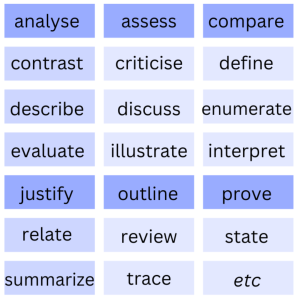
To clarify these, matching activities can be done as a warm-up exercise, with texts randomly presented for students to identify the purpose of each of them and to keep for future reference and examples.
Blank page syndrome
 It is not surprising that students with dyslexia will quickly lose confidence in their ability to write, most of all when they are asked to produce long texts with a specific number of words. Anxiety about writing is very common, so they might appreciate discussing their anxieties openly if you let them talk about what makes them anxious with an understanding attitude of respect and willingness to help. To remove the pressure of having to generate ideas you may want to try these strategies before they start writing their texts on a blank paper which can be daunting:
- invite them to just scribble a few notes, key-words or phrases,
- use automatic writing to produce a first draft by letting ideas flow,
- try using sticky notes to write ideas,
- create mind maps (see below),
- or just doodle pictures or patterns instead.
Once they have figured out what they want to include, students can proceed to organise the information by determining priorities and sorting them out. Dyslexic students will need advanced skills explicitly taught and don’t forget they will always find visuals and multisensory approaches the most useful.
Note-taking
Students with dyslexic traits can find note-taking rather challenging as it involves spelling, speed of processing and working memory skills. The skills involved in note-taking also include (a) understanding the language, (b) selecting what is important, (c) organising the information gained, (d) recognising that information, and (e) presenting it in a different way.
Here are some practical strategies to support their difficulties:
- use concept maps,
- build a word web,
- provide cloze passages where key words have been omitted,
- use templates with headings in boxes,
- don’t forget the use of colours.
Note-taking can be overwhelming too and we will not fail to support their needs with techniques like the following:
The 6 Ws = answers questions to where – what – when- what – who – how.
Timelines = are very useful for students who are more linear thinkers, for instance, for historical events, process of a project, literature, etc. (Canva.com offers superb templates for this).
Pictures = they can use pictures alongside key-words to give information (EdHelper.com is a great resource for finding templates)
Venn diagrams = tend to be useful for comparing and contrasting ideas.
Mind maps = are a great way to grow their ideas, and can enrich and develop their stories.
Finally, notes may need organising and reorganising before the final piece is produced and one way of sorting ideas out is by putting them in three different boxes: main point, supporting points, and summary; or
INTRODUCTION (10%) CONTENT (70%) CONCLUSION (20%)
Fail to plan, plan to fail
Planning and organising can be a daunting task for dyslexic students and we first need to focus on the audience as it will impact the structure and tone of their piece of writing, Therefore the following question can be asked:
Who is my piece of writing aimed at?
Mind dumping
 Writing the Introduction can be a significant challenge for your students and you actually can point out that there are times when a good conclusion may be produced first instead! In which cases the mind dump technique may come handy by removing their fear of forgetting ideas. Simply use coloured sticky notes to write down key-words, phrases and/or sentences that can later on be used to complete paragraphs.
Burger Technique
Paragraphs will then be structured following different techniques, take the burger analogy, for instance :
Frameworks
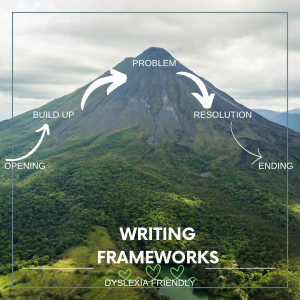
We can also support our students with dyslexia with writing stories by offering more visual pathways like the story bump technique (also known as story mountain). Writing frameworks can help students organise their written text following steps like (1) the people, (2) the place, (3) something begins to happen, (4) exciting part, (5) things begin to sort themselves out, (6) tie up lose ends.The mountain framework can be enhanced with clues on what linking expressions can be used in all stages, for instance, Once upon a time, happily ever after, etc).
Some teachers encourage their students to create their own character to base stories on throughout the school year so that their character will have been developed by the time the final written test comes. This technique can help students on exam days to write more fluently about whichever circumstances their character might have been involved in as students are more familiar with their personality traits, how they would have reacted, their strengths, etc.
Frameworks remove the pressure of having to hold the information in their head as students can start at any point of the story as well.
Storyboards
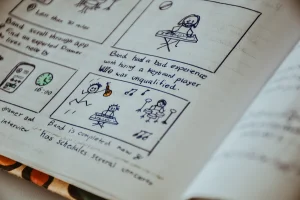 Storyboards are also a good strategy to boost students writing skills where pictures and drawings can be used to illustrate passages and create the structure of the story before students move on to focusing on grammar, vocabulary and spelling (studiobinder has is an interesting storyboaard creator with lots of free storyboard templates to support your dyslexic students).
It was during reflective activities on Amanda Hornby ‘s webinar that it dawned on me how we may fail to mark dyslexic students written tasks badly with respect to this criteria of vocabulary development simply because…
the words they use may appear simplistic, not actually reflecting their intelligence or understanding
Personalised assignments
Envelopes containing a personalised assignment in the form of a letter that you give formally to each student can be really helpful to differentiate the task for learners of different levels and/or abilities.
Storytelling dice
 You can use storytelling dice as prompts to brainstorm ideas and develop vocabulary. This activity can also be done with photographs instead of dice (the more vivid the photos, the more creative the story).
Talking books
Students with dyslexia will find audiobooks a friendly way to develop their reading skills, and not only build up vocabulary but improve understanding of language and structure (visit for resources).
Collaborative recounting
Students can be invited to rewrite passages using higher level vocabulary and to create more drama.
Checklist

Having a quick glance at their work does not qualify as proofreading their tasks before students hand in written texts. Needless to say, sufficient time must be left for this final stage. Here are some questions related to spelling, punctuation, structure, purpose and audience for students to double-check as separate tasks before their final piece is ready to reach the teacher’s desk:
- Does the text answer the question?
- Does it meet any restrictions such as word limit, format, etc?
- Is all the included information relevant?
- Are there sufficient amounts of supporting evidence?
- Are paragraphs well structured and in an appropriate order?
- Is the style and language appropriate for the audience?
- Can the text be read out easily?
- Is there a clear introduction and conclusion?
- Are the spelling (homophones in particular), grammar and punctuation (including capital letters) correct?
- Does it answer the question?
Last but not least, we should all be aware that dyslexic brains are wired differently or what has nowadays become the #dyslexicthinking asset on job search platforms like LinkedIn. Individuals with dyslexia often have brilliant ideas and very vivid imagination and not yet have the words to express their ideas. Students seem to agree that the words in their mind do not match what they manage to put on paper and often refer to having to draw pictures or create maps to be able to explain themselves. Also
- there might actually be motor skills difficulties leading to poor writing,
- physical problems that affect handwriting which becomes illegible,
- poor handwriting that may be hiding poor spelling,
- or they can’t write what they want because they cannot spell the words correctly,
- trouble retrieving words,
- their choice of words not reflecting their intelligence.